
A Settled Mind Can Withstand a World of Turmoil
The Pure Land Dharma centers on a profound truth: Amitabha Buddha directly delivers sentient beings through his radiant light, embracing those who call upon his name and never forsaking them.
In the Parable of the Two Rivers and a White Path, a traveler stands trapped on a narrow white path, lashed by waves of greed on one side and scorched by flames of anger on the other. From the western bank, Amitabha calls out: “O traveler, with a single mind and right attention, come straight toward me at once! I will protect you.”
Between the practitioner and Amitabha, there is no one else. This is how close our relationship with the Buddha is: he directly enfolds the reciter in his own light.
How wondrous and sublime is this Dharma!
Knowing that Amitabha never abandons those who recite his name — that he protects and guides us day and night with his light, and will welcome us to his Pure Land at life’s end— our minds naturally find profound peace. From this realization, we spontaneously entrust ourselves to him with unwavering faith and a genuine aspiration for rebirth in the Pure Land.
The Buddha's light and our peace of mind are two sides of the same coin. Because Amitabha's light never forsakes us, we find peace; and when we recite his name with a settled mind, our practice aligns perfectly with his Primal Vow, anchoring us securely within his radiant embrace.
This is what is meant by "the Buddha's light and the mind's light illuminating one another." The "Buddha's light" is Amitabha's radiant embrace, while the "mind's light" is the brightness of our faith.
However, we must not misunderstand what it means for the mind to be “settled”. One should never think, "Since Amitabha Buddha embraces me and will never abandon me, I can take it easy and stop reciting"
This completely misses the point.
What does a truly settled mind look like? Naturally, the practitioner recites Amitabha’s name thought after thought, never letting it go. Such a person practices with reverence, exclusively, without interruption or distraction, throughout his life.
Once we recite with a settled mind, we become one with the Buddha, bathed in his radiant light. How, then, could we ever cease to recite his name? Whether busy or at leisure, the name naturally dwells in our hearts and rolls off our tongues.
When this inner state manifests outwardly, it becomes the visible expression of our practice—the turning of body, speech, and mind toward the Buddha.
We are not frantically relying on our own self-powered efforts, trying to contrive rebirth through the accumulation of merits. Rather, because our hearts are already fundamentally at peace, these outward disciplines flow forth spontaneously from a settled mind.
Consider a young child who feels entirely secure with his mother. Whether held in her arms or playing around her knees, calling her "Mom" comes naturally and effortlessly. There is not the slightest hesitation. The word flows from a deep sense of dependence and safety.
But imagine a child kidnapped in infancy. If someone later points to a strange woman and tells him, "This is your mother; go ahead and call her 'Mom, '” his voice will be timid and hollow. Deep down, he lacks the profound security that naturally exists between a mother and her child. Even if he repeats the word ten thousand times a day, he remains estranged.
Therefore, once we understand Amitabha's Primal Vow and recite his name with a settled mind, every repetition becomes a natural outflow of the heart.
Why, then, do we still emphasize reciting the Buddha’s name so frequently in this world? Because we are immersed in the suffering of the Saha World and have long been estranged from the Buddha. Without understanding his Primal Vow, our minds remain restless. Like the kidnapped child, we live on edge, with deep-seated anxiety written in our very eyes.
For this reason, we keep reciting "Namo Amitoufo," constantly reminding ourselves that this is a world full of afflictions, while Amitabha’s Pure Land shines with magnificent purity and splendor.
We are the ones who have been kidnapped by the demon king of ignorance. Struggling inside the burning house of the Three Domains — an environment defined by impermanence, suffering, and emptiness — we are like birds once struck by an arrow. We are startled by the mere twang of a bowstring, hyper-vigilant, and full of suspicion.
This is why settling the mind is so crucial: when the mind is at peace, all is well; when it is restless, nothing feels right.
True peace cannot be found in the shifting shadows of the world. Some turn to money, power, fame, or love—but none of these can quiet an unsettled mind. Such approaches are far too shallow, for they attempt to pacify an insatiable heart, and such a heart can never be stilled.
To settle the mind, we must first understand its true nature — that it is inherently restless and unable to anchor itself. The only anchor powerful enough to quiet the human heart is Amitabha's luminous name, which removes all suffering and bestows immeasurable joy.
When people’s minds are truly at peace, they gain the strength to take life’s hardships in stride. Even when the body is afflicted by illness or circumstances turn sour, they glide through them with ease.
For life is ultimately determined by our state of mind: when the mind is at peace, everything is bearable; when it is not, even if we have the world at our feet, with limitless wealth and power, life remains an insufferable burden.
This world is in turmoil because humanity has lost the key to inner peace. Sentient beings stir and strive, chasing shadows and struggling against one another, yet they look in the wrong direction. Sadly, very few ever find true peace, and so the entire world remains in ceaseless conflict.
Only by reciting "Namo Amitoufo" — the luminous name that removes all suffering and bestows immeasurable joy — can sentient beings truly settle their minds.
This is the wondrous Dharma for settling the minds of all beings.
A person whose mind is truly settled is strong enough to withstand a world of turmoil.
(Translated by the Pure Land School Translation Team;
edited by Householder Fojin)
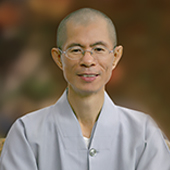
Master Huijing
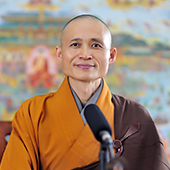
Master Jingzong
Guiding Principles
Faith in, and acceptance of, Amitabha’s deliverance
Single-minded recitation of Amitabha’s name
Aspiration to rebirth in Amitabha’s Pure Land
Comprehensive deliverance of all sentient beings